Background
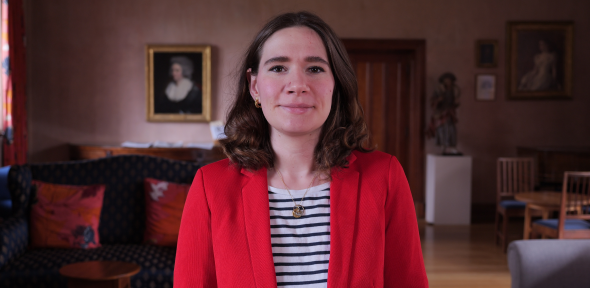
I joined the University of Oxford as Associate Professor in Modern German Culture. I am Tutorial Fellow in German at St Hugh’s and Lecturer in German at St. Anne’s. Before joining Oxford, I was Assistant Professor in German at the University of Cambridge and a Fellow of Girton College. I previously held positions at academic institutions in Ireland and the UK, including the University of Galway, the University of Birmingham, the School of Advanced Study, University of London, and the University of Warwick. I completed my PhD in German Studies at the University of Warwick.
Research
I specialise in 20th and 21st century German-language literature and culture. My interests include German Jewish cultural production, cultural engagements with (post-)migration and citizenship, and artistic responses to right-wing violence in contemporary Germany. Across these topics, I have an overarching interest in questions of remembrance and futurity and in using creative methods to diversify and disseminate my research.
I have published on these topics in peer-reviewed journals including Humanities, German Life and Letters, Oxford German Studies, Modern Languages Open, Modern Language Review, German Quarterly, and Seminar. My first monograph, Renegotiating Postmemory (Camden House, 2020) explored how Jewish writrers in contemporary Germany and Austria negotiate major shifts that have ocurred in Holocaust memory since the turn of the millennium in and through their writing.
I am currently completing a new book which examines how a range of contemporary German-language authors from minoritised backgrounds and beyond tackle the challenges of Germany’s postmigrant society through literary experiments with alternative modes of relationality and worlding. I argue that, through formal experimentation, their texts generate ‘nonreproductive’ modes of being in the world and with others that have the power to open up different, less violent futures.
As part of this research, I have developed an interest in cultural engagements with right-wing violence in post-unification Germany, which has resulted in ongoing collaborations with contemporary writers including Esther Dischereit as well as Çetin Gültekin and Mutlu Koçak.
I was elected into the Young Academy of Ireland under the auspices of the Royal Irish Academy in 2024. In October 2025, I joined the editorial board of German Life and Letters.
Teaching
I offer lectures, tutorials and seminars in the following areas of the Prelims and FHS German course:
- Paper IV – Prose and Poetry
- Translation from/into German (Prelims and FHS)
- Paper VIII
- Paper X – Brecht (TT 2026)
- Paper XII – German Jewish Literature since 1945 (HT 2026)
Graduate Supervision
I have supervised graduate work in the areas of contemporary German Jewish cultural production, especially (post-)memory discourses and Jewish migrations. I welcome inquiries from potential candidates interested the following areas: German Jewish cultures; post-1945 memory cultures; literatures of migration; representations of race and racialised violence in contemporary German-language literature; futurisms in contemporary German literature.
Publications (Selection)
Monographs:
- Renegotiating Postmemory. The Holocaust in Contemporary German-language Jewish Literature (Camden House, 2020); reviewed in: Choice Reviews; German Quarterly; Gegenwartsliteratur; Journal of Austrian Studies; Yearbook of European Jewish Literature Studies; Forum for Modern Language Studies.
Edited volumes:
- With Godela Weiss-Sussex and Elizabeth Stewart, Postmigrant Approaches to Contemporary Jewish Cultural Production (under review with De Gruyter).
Peer-reviewed articles:
- With Rebecca Braun, and Orla Lehane, ‘Harnessing Fiction for Social Futures – The Literary Futures Method’, Futures, 158 (2024), https://doi.org/10.1016/j. futures.2024.103348.
- ‘Unrecognizable Subjects, Grief, and Repair in Esther Dischereit’s Blumen für Otello’, German Studies 53.1 (2024), pp. 107–121.
- ‘“Stories one tells in dark times”: Fabulation, Fugitivity, and Futurity in Olivia Wenzel’s 1000 Serpentinen Angst’, The German Quarterly, 97.1 (2024), pp. 75-92.
- ‘Irreconcilable Differences: The Politics of Bad Feelings in Contemporary German Jewish Culture’, Edinburgh German Yearbook 14, pp. 75-96.
- ‘Moments of Possibility. Holocaust Postmemory, Subjunctivity, and Futurity in Katja Petrowskaja’s Vielleicht Esther (2014) und Robert Menasse’s Die Hauptstadt (2017)’, Forum for Modern Language Studies 56.4, pp. 406-426.
- ‘Postmigrant Renegotiations of Identity and Belonging in Contemporary Germany’, Humanities 9.2, https://doi.org/10.3390/h9020042.
- ‘Ec-static Existences: The Poetics and Politics of (Non-)Belonging in Sasha Marianna Salzmann’s Außer Sich (2017)’, Modern Languages Open, online: http://doi.org/10.3828/mlo.v0i0.284.
- ‘Rethinking “Minor Literatures” – Contemporary Jewish Women’s Writing in Germany and Austria’, Modern Languages Open, http://doi.org/10.3828/mlo.v0i0.285.
Peer-reviewed book chapters:
- ‘Literary Archives and Alternative Futures. Memories of Labor Migration in Contemporary Turkish German Fiction’, in: The Palgrave Handbook of European Migration in Literature and Culture, ed. Charlotte Sussman and Corina Stan (Palgrave, 2023), pp. 255-270.
- ‘“We will be ephemeral” – Encounter, Community and Unsettled Cosmopolitanism in Senthuran Varatharaja’s Vor der Zunahme der Zeichen’, in: Exploring the Transnational Neighbourhood, ed. Stephan Ehrig, Britta Jung and Gad Schaffer (Leuven UP), pp. 69-92.